Four SEO skills on one homepage: only Sweep 4 found the gap
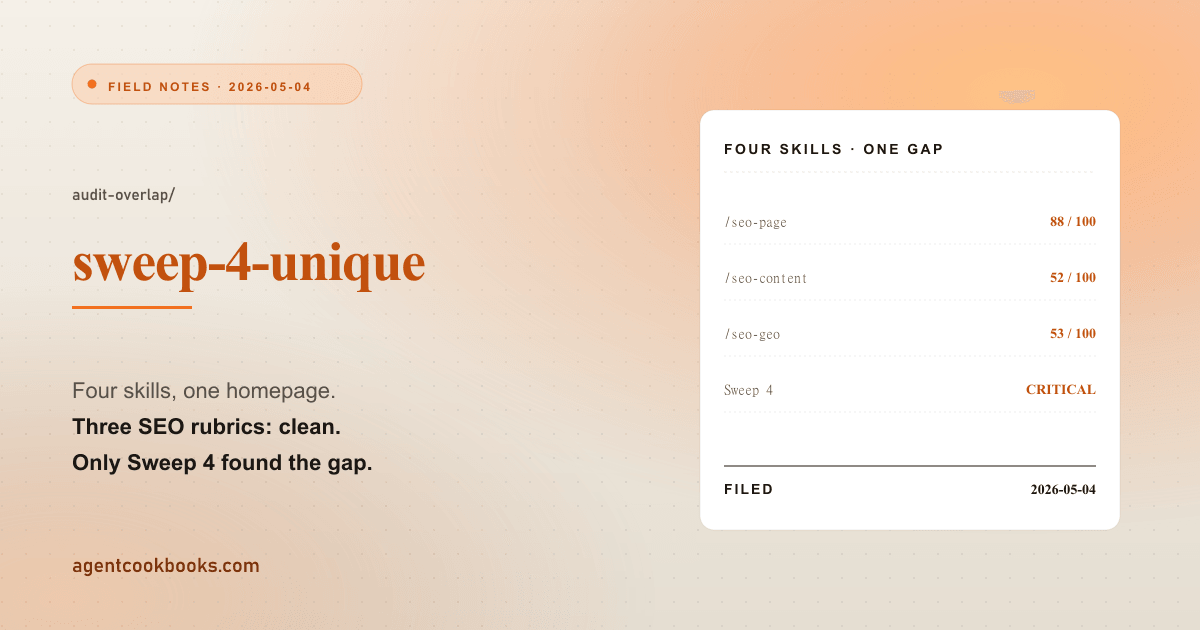
Four skills on the same live homepage, run in sequence: /seo-page (88/100 on-page), /seo-content (E-E-A-T 52/100, AI Citation 72/100), /seo-geo (53/100 GEO), and /copy-editing (5 of 7 sweeps clean). Three SEO-framed audits returned scored findings already covered by their respective frameworks. Only /copy-editing Sweep 4 (Prove It) caught a critical structural gap — claim-vs-proof colocation — that the other three all missed from different framings. The receipt below: what each rubric is wired to find, why three frameworks missed the same gap, and why on receipts-first sites Sweep 4 belongs first in the audit stack.
The three SEO rubrics: scores and findings
Each of the three SEO-framed audits ran end-to-end and produced numerical scores plus prioritized findings. None of them flagged the gap that Sweep 4 caught.
| Skill | Score | What it surfaced | The gap it didn’t isolate |
|---|---|---|---|
/seo-page | 88/100 on-page | Title chars, schema integrity, internal-link count, body word count | Page-level evidence-presence check; doesn’t isolate per-claim colocation |
/seo-content | E-E-A-T 52/100 | Experience 14, Expertise 12, Authority 8, Trust 18; brand-anonymity ceiling explicit | Folds proof into Experience as one of four equally-weighted signals |
/seo-geo | 53/100 GEO | Citability 16/25, Multi-Modal 3/15, robots.txt edge conflict | Measures citability of what’s there; no rubric for what’s missing-but-claimed |
Two structural-ceiling caveats are worth naming before reading those scores as fix-list items: /seo-content Authority 8/25 and /seo-geo Authority/Brand 6/20 are both policy-capped by the site’s brand-anonymity rule (no author bios, no operator-driven brand mentions). Authority is the dimension where the rubrics punish anonymity by design. Same root cause across both frameworks; different rubric framings. The corpus-wide E-E-A-T audit ran two weeks later confirmed the ceiling holds at ~5/10 Authority across all 197 skills + 20 posts — the homepage scores aren’t an outlier, they’re the structural cap.
What’s important for the rest of this post: every category each of these three rubrics flagged was a known category of finding. Title length. Multi-modal asset count. Robots.txt edge config. Schema completeness. The audits behaved as designed.
What Sweep 4 caught that the others didn’t
/copy-editing Sweep 4 is the Prove It sweep — for every claim on the page, check whether the evidence is colocated with the claim itself.
The homepage makes three editorial-bar claims, all in close proximity:
- “the JSON, the timings, and the failure modes from real use” (lede)
- “a working hook, a measured cost, a documented failure mode” (body paragraph)
- “no AI-generated filler” (eyebrow + body)
Three claims, all asserting the site ships proofs. Zero proof artifacts inline on the homepage itself. The proofs exist — they’re in the blog posts and the wiki entries. But a reader landing on the hub has to click through to verify any of them.
That’s the gap. Not a content quality issue. Not a structured-data issue. Not a citability issue. It’s a proof colocation issue: the page makes claims and outsources every verification to one click away.
Why three rubrics missed the same gap
Each of the three SEO-framed rubrics has a related check. None has the same one.
/seo-page scores Content Quality at the page level — does this page have evidence, schema, supporting links. Page-scope pass/fail. The check is “is there evidence somewhere on the page” not “is each specific claim’s evidence within reading distance of the claim.”
/seo-content Experience scoring is the closest of the three. Its Experience 14/25 score on the homepage specifically reflects this gap — strong claim, no proof artifact on the page itself. But Experience is one of four E-E-A-T dimensions, weighted equally in the rubric. The colocation issue lives inside Experience, gets averaged into a 52/100 E-E-A-T total, and surfaces as one bullet among many. It doesn’t get its own rubric line.
/seo-geo measures Citability 16/25 — quotable lede, structured answer block, citation-friendly content. It scores whether what’s on the page is citable for AI engines. It doesn’t score whether the page is missing citable proof for its own assertions.
/copy-editing Sweep 4’s framing is unique because colocation is the unit of analysis. Each claim gets checked against its own neighborhood for matching evidence. A claim with proof colocated passes; a claim with proof one click away fails — not because the proof doesn’t exist, but because the colocation is broken.
This isn’t framework bias. It’s framework coverage. Three rubrics with related-but-not-identical checks, none of which has a per-claim-colocation lens.
The corpus-wide validation
The same Sweep 4 was run across all 10 published blog posts in a separate audit. Result: 10 of 10 PASS.
Every blog post on this site has its claims colocated with its proofs:
claude-code-frontmatter-guard-hookships verbatim stderr blocks alongside the claim that the hook surfaces frontmatter errors. Stderr is the proof.cloudflare-ai-audit-robots-txt-trapleads with the byte-count diff (2,704 vs 966) before the prose explanation. Diff is the proof.cloudflare-pages-csp-pagefindships the full 14-line_headersconfig inline with the per-directive reasoning two paragraphs down. Config is the proof.
Same skill, same Sweep 4 rubric, opposite verdicts on different surfaces. The blog posts pass because each one has 1–3 specific claims and shows the corresponding proofs in adjacent sections. The homepage fails because it aggregates the corpus’s claims (the editorial-bar promise) and can’t show all the corresponding proofs at once.
The actionable read: the editorial discipline IS being practiced at the post level. The hub level just doesn’t inherit it. The fix isn’t a content rewrite — it’s a single ~80-word inline-receipt block on the homepage that borrows one of the corpus’s proofs into the hub’s content surface.
What this means for audit ordering
On any site that publishes editorial-bar claims (receipts-first, evidence-based, “with real X” framing), the most failure-prone audit category is the colocation gap. Three SEO-framed audits won’t catch it. One copy-editing sweep will.
Practical order for receipts-first sites:
- Run
/copy-editingSweep 4 first on the homepage and high-traffic landing pages. If colocation is intact, the rest of the audit shifts from “find the critical gap” to “validate everything else.” - Then run the SEO-framed audits. They’ll surface their structural-ceiling findings (anonymity caps, multi-modal asset gaps, technical fundamentals) which have nothing to do with claim-proof colocation. Those are real findings; they’re just orthogonal to the gap Sweep 4 catches.
- Don’t read three “evidence-related” rubric lines as the same finding. They aren’t.
/seo-page’s Content Quality,/seo-content’s Experience, and/seo-geo’s Citability all touch evidence, but none of them has the per-claim-colocation lens that Sweep 4 has. The overlap is closer to “they all care about evidence” than “they all check the same thing.”
Related: the cross-skill convergence finding from the page-cro audit on the same homepage — /page-cro Quick Win #3 is the same gap as Sweep 4, scored from a CRO framing instead of a copy framing. Two skills agreeing from different framings is a stronger signal than either scoring it critical alone. The lesson there is convergence; the lesson here is that three skills NOT finding it doesn’t mean the gap isn’t there — it means the gap lives in a category none of the three rubrics covers.
The receipt is the unique-finder finding: four skills, one URL, only one rubric was wired for the question that mattered. The same rubric applied corpus-wide returned the inverse verdict (10/10 PASS at the post level), which is what makes the homepage gap an inheritance problem instead of a discipline problem.
For the prior parallel audit on Astro source files, see Three SEO skills on pre-launch Astro: what each caught. Three skills, source files, no live URL — a different shape but the same skill-overlap-and-coverage discipline.